
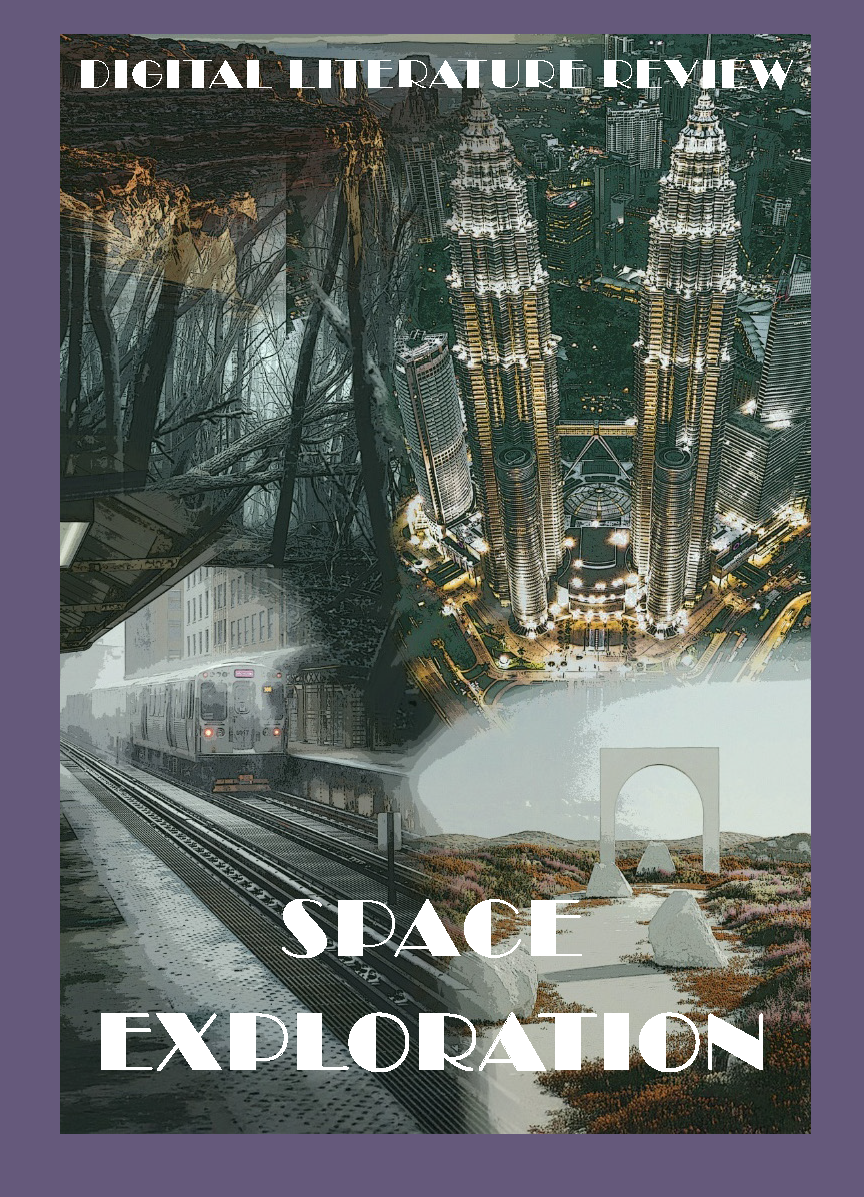
Space Exploration
Examining How Physical and Theoretical Spaces Shape Us
DOI:
https://doi.org/10.33043/DLR.13.1.6-12Keywords:
SpatialityAbstract
The spatial turn in literary studies draws attention to space as more than a backdrop to our lives and stories. It treats space as an active force that shapes individual identity and plays a key role in the construction of social orders. Spatial literary analysis, or what we are calling “Space Exploration,” considers how these impacts are represented in literature and other creative texts. This year’s Digital Literature Review explores how real and imagined spaces structure identity, society, and narrative.
Downloads
References
Baudrillard, Jean. Simulacra and Simulation. Translated from the French by Sheila Faria Glaser. U Michigan P. 1994.
Bhabha, Homi K. The Location of Culture. Routledge, 2004.
Bishop, Elizabeth. “The Map.” North & South, Houghton Mifflin, 1946.
Erickson, Dan, creator. Severance. Endeavor Content/Red Hour Productions, 2022. Apple TV, https://tv.apple.com/us/show/severance/umc.cmc.1srk2goyh2q2zdxcx605w8vtx
Foucault, Michel. “Of Other Spaces.” Translated by Jay Miskowiec, Diacritics, vol. 16, no. 1, 1986, pp. 22-27. JSTOR, https://doi.org/10.2307/464648.
Jameson, Frederic. Postmodernism, or, The Cultural Logic of Late Capitalism. Duke U P, 1991.
Richardson, Bill. “Mapping the Literary Text: Spatio-Cultural Theory and Practice.” Philosophy and Literature, vol. 42 no. 1, 2018, p. 67-80. Project MUSE, https://dx.doi.org/10.1353/phl.2018.0003.
Said, Edward. Orientalism. Vintage Press, 1978.
Spivak, Gayatri. “Can the Subaltern Speak?” in Marxism and Interpretation of Culture, Edited by G. Nelson & L. Grossberg, U of Illinois, 1988, pp. 271-313.
Wilson, August. Fences. Plume, 1986.
Downloads
Published
How to Cite
Issue
Section
License
Copyright (c) 2026 Kathryn Ludwig, Margaret True

This work is licensed under a Creative Commons Attribution-NonCommercial-NoDerivatives 4.0 International License.