Fifty-Years and the Evolving Role of Special Education Teachers
DOI:
https://doi.org/10.33043/2yc9rqq4Keywords:
Evidence Based Practices (EBPs), High Leverage Practices (HLPs), Special Education, Teacher Roles, IDEAAbstract
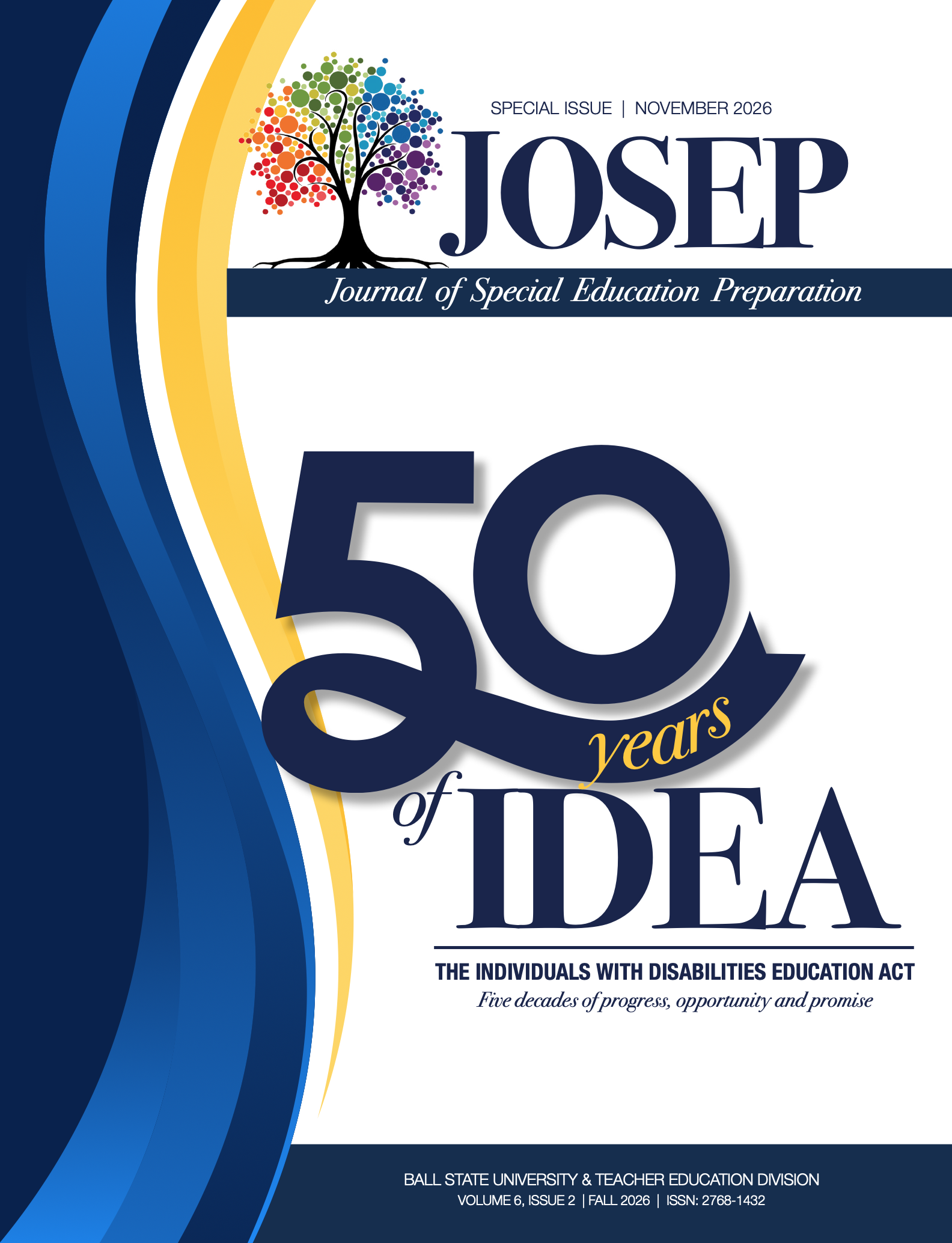
The 50th anniversary of the Individuals with Disabilities Education Act (IDEA) provides an opportunity to reflect on the evolution of special education and the changing role of special education teachers. Since the passage of the Education for All Handicapped Children Act of 1975, federal legislation, judicial rulings, and advances in research have expanded expectations from ensuring access to public education to promoting meaningful participation, progress, and post-school outcomes for students with disabilities. This article traces key historical, legal, and scholarly developments that have shaped special education across the past five decades and examines how these changes have transformed the work of special education teachers. Building on contemporary perspectives of the profession, we describe nine interconnected roles of modern special educators: collaborator, instructor, advocate, scientific practitioner, role model, classroom manager, leader, peer mentor, and teacher technologist. We discuss the knowledge, skills, and professional dispositions needed to fulfill these roles and highlight how adaptive expertise enables teachers to integrate them in response to diverse student needs and educational contexts. Implications for teacher preparation, research, and practice are explored, with particular attention to the importance of practice-based learning, reflection, feedback, and field experiences. As IDEA enters its next half-century, preparing special educators who can adapt to emerging technologies, evolving policies, and changing educational demands will be essential. We conclude by celebrating the progress achieved during IDEA’s first fifty years while emphasizing the continued responsibility of the profession to expand opportunities and improve outcomes for students with disabilities.
Downloads
Downloads
Published
How to Cite
Issue
Section
License
Copyright (c) 2026 Sarah Nagro, Andrew Markelz, Mary Catherine Scheeler, Laurie deBettencourt

This work is licensed under a Creative Commons Attribution 4.0 International License.